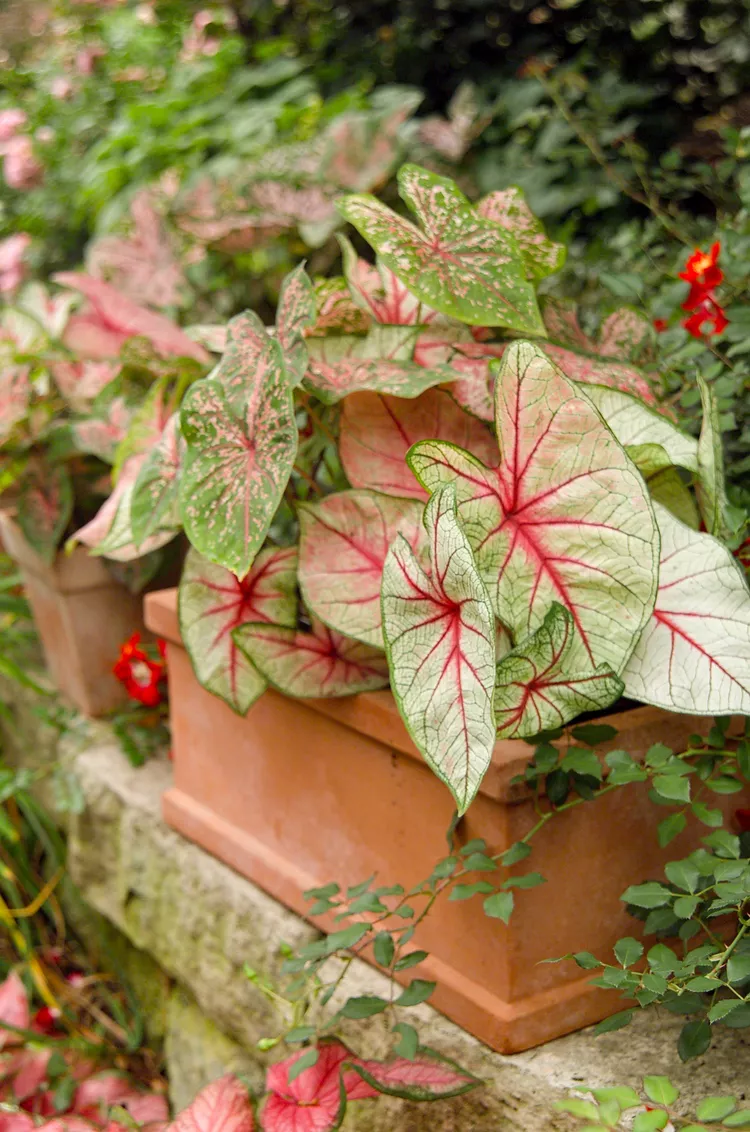
Caladium is a genus of tropical plants native to South and Central America. They are commonly grown as annuals or their bulbs are dug up each fall and replanted every spring like dahlias. They are also suitable to be grown as houseplants.
Caladiums were initially limited to shadier locations with a couple of hours of dappled sun or less intense morning sunlight. However, newer varieties tolerate some direct sunlight, especially in northern areas.
Most caladiums sold in the nursery trade today are cultivars of Caladium bicolor, and there are hundreds of them to choose from. Caladiums are sometimes referred to as elephant ears or angel wings. Verify the genus name Caladium on the plant tag because other plants such as alocasia also go by those common names.
Caladium is toxic to humans and pets.
Caladium Overview
| Genus Name | Caladium spp. |
| Common Name | Caladium |
| Plant Type | Bulb |
| Light | Part Sun, Shade, Sun |
| Height | 12 to 30 inches |
| Width | 12 to 30 inches |
| Foliage Color | Blue/Green, Gray/Silver, Purple/Burgundy |
| Special Features | Good for Containers, Low Maintenance |
| Zones | 10, 11, 9 |
| Propagation | Division |
| Problem Solvers | Groundcover |
Where to Plant Caladium
Depending on your zone and the variety’s sun tolerance, plant caladium in full sun to partial shade. The soil should be naturally moist but well-drained and slightly acidic.
The key to an eye-catching caladium planting is quantity. Plant at least three caladiums together for a bold statement. If you have space, a mass planting of five or seven plants is even better. Choose a single variety for the best effect.
For the front of a border, select lance-leafed caladiums, which usually don’t grow taller than 12 inches.
In containers, plant only caladiums or combine them with other shade-loving annuals such as impatiens or begonias. More sun-tolerant varieties also pair well with cannas and calibrachoa.
How and When to Plant Caladium
Caladiums are planted in the spring after soil temperatures remain consistently above 70 degrees F. Don't plant these heat-lovers too early; the plants don’t grow in colder temperatures and if the soil is too cold, the tubers will rot.
If possible, purchase larger bulbs. The more buds are on a bulb, the more foliage the plant will grow. Smaller bulbs still make attractive plants, they just won’t get as large.
Plant the bulbs so their puckered or knobby sides (eyes) are face up. Cover them with 1.5 to 2 inches of soil.
Space bulbs 8 to 12 inches apart, jumbo bulbs need maximum spacing. Smaller bulbs or those in containers can be planted closer together.
Caladium Care Tips
Caladium rightfully has the reputation of being an easy-to-grow garden ornamental.
Light
The light requirements depend on the type of caladium. Traditional varieties prosper in partial shade while many newer varieties are tolerant of full sun, especially in cooler northern areas.
Soil and Water
Caladiums thrive in moist, organically rich, acidic soil with a pH between 6.0 and 6.5. Amend the soil with compost or other organic matter before planting if needed.
Excellent drainage is important—caladium tubers are prone to rotting if the soil is too wet.
Unless there is frequent rainfall, regular watering is needed to keep the soil evenly moist during the entire growing season. Make sure to water the plants at the base and avoid getting the foliage wet.
Temperature and Humidity
Caladiums are tropical plants that thrive in hot and humid conditions. In southern locations with warm, frost-free winters, leave the bulbs in the ground year-round. Below Zone 9, they are not winter-hardy but you can save the bulbs for planting the following year by digging them up before the first fall frost and overwintering the bulbs indoors.
Fertilizer
To support their vigorous growth, caladiums need regular fertilization during the growing season in the spring and summer. Use a complete all-purpose garden fertilizer that is low in nitrogen and follow the directions for frequency and dosage. Excess nitrogen may affect the leaf color.
Pruning
Other than removing damaged and dead leaves, there is no need to prune caladium. The plant rarely blooms but if it develops flower bracts, remove them so the plant directs all its energy on growing foliage.
Potting and Repotting Caladium
Use a combination of high-quality potting mix and compost to fill a pot with large drainage holes. Caladiums do not require very large pots, a pot that is about 5 times as big as the bulb is generally sufficient for a single plant. If planting several caladiums in one pot, use a pot that is large enough to space the bulbs about 6 inches apart.
Remember that potted plants need more frequent watering and fertilizer than plants in garden soil.
For caladiums grown as annuals, repotting won’t be necessary.
Pests and Problems
Caladiums are bothered by only a few pest problems. Potential pests include caterpillars, aphids, mealybugs, mites, thrips, and whiteflies. If their numbers are small, manual removal usually works, otherwise treat the plant with insecticidal soap. Slugs may also feed on the plant.
Rotting of the bulbs usually occurs in wet or cool conditions. To prevent it, delay the planting until the weather is warm.
Too much sun leads to leaf burn or leaf scorch in cultivars with thin leaves or varieties that are less sun-tolerant.
How to Propagate Caladium
Caladium is propagated by division in the spring just as the new growing season starts. Cut the clump of bulbs into smaller sections with at least one eye or knob. Let the sections dry in a well-ventilated place indoors for a few days so they callus over, then replant as described above.
Types of Caladium
'Florida Cardinal' Caladium
Part of a thicker-leaved caladium series bred in Florida for sun tolerance, this variety produces red heart-shaped leaves broadly bordered in green. It grows 20 inches tall.
'Florida Elise' Caladium
'Florida Elise' bears vibrant splashes of silvery pink that highlight the 16-inch-long leaves. This variety takes more sun than most and grows 18 to 30 inches tall.
'Florida Red Ruffles' Caladium
Here is another sun-tolerant selection. It has narrow, heart-shaped leaves in a dramatic shade of dark red and edged in lime green. It grows 12 to 14 inches tall.
'Miss Muffet' Caladium
'Miss Muffet' produces pink veins on lime-green leaves and is embellished with burgundy spots. This dwarf variety grows 12 inches tall.
'Marie Moir' Caladium
Each heart-shaped leaf of this rare variety is splashed with blotches of red. It grows 24 inches tall.
'Gingerland' Caladium
'Gingerland' bears intricate veining of maroon, pink, and green in a showstopping combination on the leaves. It ranges in height between 12 and 24 inches.
'White Queen' Caladium
'White Queen' is a classic with silvery-white leaves etched with rich red and green veining. Each leaf grows 10-20 inches long. It grows 24 inches tall.
'Red Flash' Caladium
This bold variety offers deep fuchsia-pink veins and pale pink splotches on the dark green, glossy leaves. It grows 24 inches tall.
Caladium Companion Plants
Licorice Plant
With its soft colors and textures, licorice plant (Helichrysum) is a harmonious backdrop for more brightly colored blossoms. It has small leaves and thin stems, but it is much tougher than it looks. It will thrive in hot, humid weather and tolerate drought well. Plus, its fuzzy, scented foliage prevents pests from bothering the plant. Licorice plant is a perennial but commonly grown as an annual. Zone 9-11
Coleus
Coleus is a popular annual that comes in an amazing array of color combinations and leaf textures, adding colorful foliage to your landscape. Select a shade-loving variety of edged-leaf coleus, veined-leaf coleus, or trailing coleus for shady locations. What all coleus have in common is that they are easy-to-grow annuals that need warm and moist soil and regular fertilization to sustain their vigorous growth.
Elephant's Ear
In warm climates, elephant’s ear (Alocasia) can be grown outdoors year-round, either in the landscape or in large containers. In cooler climates, similar to caladium, elephant’s ear is a perennial that is either grown as an annual and replanted every year or overwintered indoors. With its huge leaves and bold vein patterns, it grows wherever there’s moist soil and warm temperatures. It’s striking alongside ponds where its massive leaves create beautiful reflections in the water. Zone 10-11