
Dog tooth violet is not a violet but a genus in the lily family, named after the toothlike shape of its white underground bulb. Known by a host of common names—trout lily, fawn lily, and adder's tongue—this woodland wildflower is a harbinger of spring. It grows in the shade and spreads slowly to form colonies of mottled strappy foliage, similar in appearance to the skin of a spotted trout or fawn, below stems of nodding, lily-like flowers in yellow, white, or pink in early to midspring.
There are about 20 species in the Erythronium genus, most of them native to western North America but there are also some that are native to eastern North America and Eurasia. Dog tooth violet is one of the spring ephemerals—flowers that display all their beauty during a very short period in the spring. Their foliage withers and dies after blooming and only the underground structures remain, invisible to the eye, making it all the more important to mark the planting location well.
Dog's-Tooth Violet Overview
| Genus Name | Erythronium spp. |
| Common Name | Dog's-Tooth Violet |
| Additional Common Names | Yellow Trout Lily, Yellow Fawn Lily, Yellow Adder's Tongue |
| Plant Type | Bulb, Perennial |
| Light | Part Sun, Shade |
| Height | 4 to 6 inches |
| Width | 3 to 6 inches |
| Flower Color | Pink, White, Yellow |
| Foliage Color | Chartreuse/Gold |
| Season Features | Spring Bloom |
| Zones | 3, 4, 5, 6, 7, 8, 9 |
| Propagation | Division |
| Problem Solvers | Slope/Erosion Control |
Where to Plant Dog Tooth Violet
Choose a location in partial shade with moist soil and a neutral pH.
The best effect is created by mass plantings or drifts. Find a location where the plant can remain undisturbed, which increases the likelihood of it naturalizing over time.
Tuck this graceful spring bloomer into shade gardens, woodland plantings, shaded areas of rock gardens, or around shrubs. Thriving in moist or wet soil, it also grows well along stream banks and beside ponds. Plant it on stream banks to help prevent erosion. Pair dog tooth violet with other spring-blooming woodland wildflowers for a springtime flower show. After dog tooth violet retreats underground in the heat of summer, choose perennial companion plants that will mask the empty garden spots, such as ferns.
How and When to Plant Dog Tooth Violet
Plant the bulbs immediately after you receive them, as dog tooth violet does not fare well when being outside the soil.
Plant them with the most pointed end up, 3 to 4 inches deep, which is deeper than you might expect for such a small bulb, but the extra depth is necessary for this plant to overwinter without damage. When you receive the bulbs, they might look dry and discolored, which does not affect their viability.
Space the bulbs 4 to 6 inches apart depending on the height of the variety.
Dog Tooth Violet Care Tips
Other than providing the plant with conditions that mimic its native habitat, it requires minimal care.
Light
Dog tooth violet grows best in part shade or filtered shade.
Soil and Water
The soil should be rich in organic matter and moist soil, not only during the growth period of the plant. Plants maintain their foliage longer in moist soil.
The ideal pH is in the neutral range, between 6.8 and 7.2.
Temperature and Humidity
Most Erythronium species are winter-hardy and withstand chilly temperatures, though some species and varieties are slightly hardier than others. All dog tooth violets flourish in cool damp climates and struggle in humid heat. In areas with hot, dry summers, they need a well-shaded spot where the soil does not get parched by the sun.
Fertilizer
Rather than feeding the plant a commercial fertilizer, apply a 2-inch layer of compost around the plants every spring. Don’t remove the leaf litter from nearby trees, which also returns nutrients to the soil as the leaves decompose.
Pruning
Don’t prune the plant after the bloom; instead, let the mottled, deep-green foliage die back on its own in midsummer. It will reappear the following spring.
Potting and Repotting Dog Tooth Violet
Like other bulbs, dog tooth violet is not suitable for growing in pots because the roots are not sufficiently insulated against the winter cold and the summer heat. Frequent temperature fluctuations and cycles of freezing and thawing in the winter also decrease the chance of the bulbs surviving the winter in a container.
Pests and Problems
Except for snails and slugs, dog tooth violet is not bothered by major pests or diseases. It is rarely browsed by deer.
How to Propagate Dog Tooth Violet
The plant naturalizes by growing bulb offsets (bulbils) on the sides of the bulbs. Using those for propagation is gentler than digging out the entire clump and dividing it. During the dormant season in the late summer or early fall, carefully remove the bulbils without digging up the bulbs. Replant the bulblets following the instructions under How to Plant Dog Tooth Violet.
Types of Dog Tooth Violet
Yellow Trout Lily
Erythronium americanum is one of the most common and widespread dog tooth violets in North America. It produces a single single, nodding, bell- or lily-shaped yellow flower on leafless stems emerging from mottled foliage. It grows 4 to 6 inches tall. Zone 3-8
Giant White Fawn Lily
Erythronium oregonum, also known as the Oregon fawn lily, is native to western North America. It has creamy white nodding flowers with butter-yellow centers and few but thick, broad leaves. It grows 8 to 10 inches tall. Zone 6-9
'Pagoda'
This cultivar is a hybrid between two native North American species, Erythronium tuolumnense and Erythronium revolutum. It produces up to five golden-yellow flowers on each stem. The petals on Erythronium 'Pagoda' reflex to reveal a reddish ring at the base and bloom in mid to late spring. The leaves are thick and veined in whitish green. It grows 12 to 14 inches tall. Zone 3-8
'White Beauty'
Erythronium revolutum 'White Beauty' is a petite cultivar that only grows 5 to 9 inches tall. It has creamy white flowers that turn white as they age. Zone 3-9
'Purple King'
This is a cultivar of Erythronium dens-canis, the only species of dog tooth lily native to
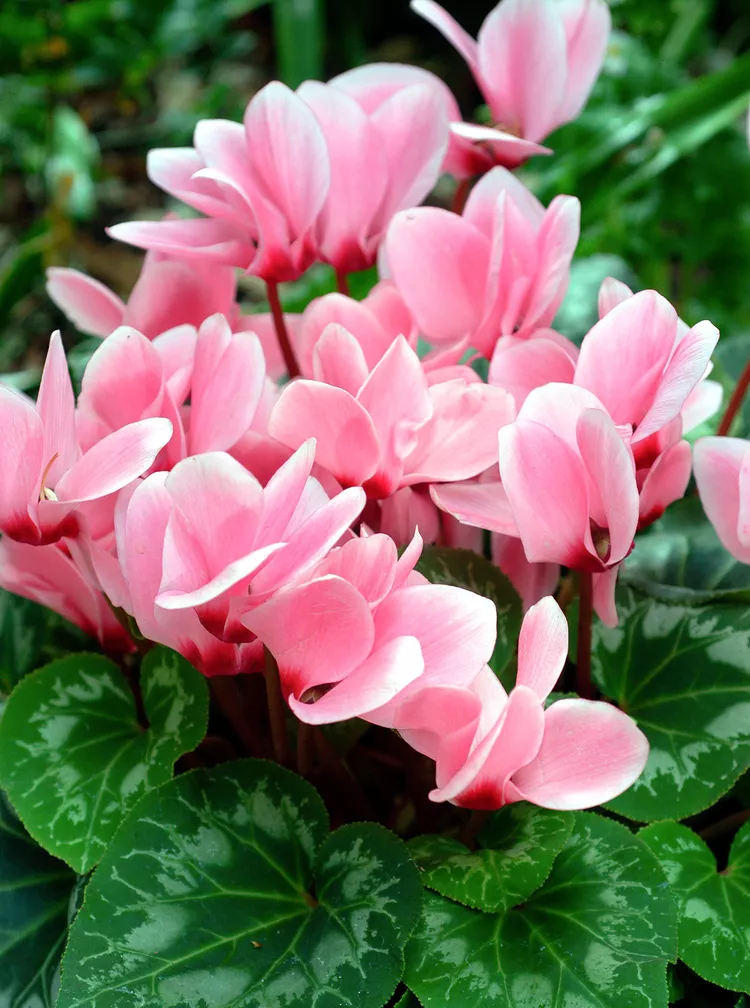
central and southern Europe. The large, reflexed flowers have a fuchsia coloring and reddish-brown-throated base, resembling large cyclamen. It grows 5 inches tall. Zone 3-8
Dog Tooth Violet Companion Plants
Virginia Bluebells
Virginia bluebells (Mertensia virginiana) is another native plant that adds woodland beauty to your garden. The blue, bell-shaped flowers open above bright green foliage in midspring. After the bloom, at the beginning of summer, Virginia bluebells recede into the soil and their foliage slowly dies back. Zone 3-8
Jack in the Pulpit
Jack-in-the-pulpit (Arisaema triphyllum) blooms in the spring and then disappears for the summer. The intricate, cuplike, purple-striped flowers of this native perennial have a hooded top (a spathe) in earthy colors like green, cream, burgundy, and brown. From the center of the cup, a pollen-bearing spike peeks out, resembling a person standing in a pulpit. As the flowers fade, the plant produces a cluster of red berries mid to late summer. These berries become more visible as the spathe withers and shrinks, adding a late dash of color to the shade garden. Zone 3-9
Coral Bells
These dependable perennials are grown as much for their flowers as for the unusual mottling and veining of different-color leaves. The low clumps of long-stemmed evergreen or semi-evergreen lobed foliage make coral bells fine groundcover plants that grow both in sunny and shady locations. Zone 3-9