Clematis is one of the best perennial vines for your garden. These plants dress up any structure they climb with their flowers that come in an array of shapes and colors. Bloom time ranges from late spring to fall, depending on the type and variety. With a little planning and the proper clematis care, you'll have blooms in your garden throughout the growing season. You can even plant these vigorous vines alongside sturdy woody plants such as roses, trees, or shrubs to act as a living trellis.
The bloom time of clematis vines varies depending on the species. Many new varieties are rebloomers, but most older types will only bloom for one season. However, even after blooming, clematis flowers add interest. As the seed heads mature, they expand to become fluffy balls that look especially pretty in dried floral arrangements.
Clematis Overview
| Genus Name | Clematis |
| Common Name | Clematis |
| Plant Type | Perennial, Vine |
| Light | Part Sun, Sun |
| Height | 3 to 8 feet |
| Width | 3 to 20 feet |
| Flower Color | Blue, Pink, Purple, Red, White, Yellow |
| Foliage Color | Blue/Green |
| Season Features | Fall Bloom, Spring Bloom, Summer Bloom, Winter Interest |
| Special Features | Attracts Birds, Fragrance, Good for Containers, Low Maintenance |
| Zones | 4, 5, 6, 7, 8, 9 |
| Propagation | Seed, Stem Cuttings |
Clematis is toxic to people, but the leaves have a bitter taste, which helps deter much sampling. The plant is also known to be toxic to dogs, cats, and horses.
Where to Plant Clematis
Clematis is a perennial vine that grows in USDA Hardiness Zones 4–9. It thrives in the garden or planted in containers. Although most clematis plants are vining types, there are some shrubby clematis varieties available.
Some clematis varieties can be aggressive growers or even invasive species in some regions. Check with your local Extension Office before planting and deadhead blooms to prevent the spread of any aggressive types.
Clematis Care Tips
Clematis care is easy if you keep a few things in mind about this perennial vine. Use these clematis care tips to have the best results with your plants.
Light
Clematis generally prefers full sun, but a few varieties can grow in partial shade. Part shade means 4 to 6 hours of direct sun per day, mainly in the morning. Full shade is less than 4 hours of direct sun per day.
Important note: Although the plant's leaves thrive in warm sunlight, clematis prefers cool roots, so plant it at the base of another plant that will provide shade over the plants' roots.
Soil and Water
A clematis prefers well-drained soil and consistent moisture. Certain species are more drought-resistant and can handle dry soils better than others. Clematis likes neutral soil, so if your soil tends to be more acidic, add lime every so often to modify its pH balance. If the top 1 inch of soil is dry, it's time to water your clematis.
Fertilizer
Clematis has a reputation as a heavy feeder, so don't neglect regular fertilization. Begin in the spring after the buds form and use a low nitrogen fertilizer (5-10-10). Continue to feed the plant every four weeks or so throughout the season using a balanced 10-10-10 fertilizer.
Pruning
Pruning clematis vines is quite simple. There are three main classes when it comes to pruning, numbered accordingly. The group numbers indicate how to prune. To start, no matter which group number vine you have, it's always a good idea to give plants in their first year a good spring pruning.
Group 1: Plants will bloom on old wood (growth from previous seasons), so if needed, prune them right after blooming. Clean up these vines lightly in early spring, but be aware that any live growth you remove is, in fact, a potential flower you've just cut. Try only to cut off dead wood.
Group 2: Vines bloom on both new and old growth. Typically, most of their blooms will appear in spring, but they'll also put on another floral show of new growth in the fall. With this group of clematis, you can do some mild pruning in early spring, especially removing dead wood. Any major work should be done just after the primary bloom in spring.
Group 3: Vines all bloom only on new wood. These types of clematis vines are easy to grow and can be cut back every spring to about 8-12 inches above the ground. Plants can become overgrown and unruly if you don't cut Group 3 back each spring.
How to Propagate Clematis
You can propagate clematis with seeds by planting them in a flat of seed-starting mix and keeping it moist, but it can take several months before you see any results.
Taking softwood stem cuttings from a healthy plant in April or May is a better method for propagating clematis. The cutting must contain a leaf bud. Press the cuttings into a small pot filled with compost or seed-starting mix, water, and cover with a plastic bag. When they root, transfer them to separate containers. It can take as long as a year for the seedlings to be robust enough to be planted outdoors.
Types of Clematis
Whether it's a summer-blooming variety with large, showy blooms or a fall-blooming type of clematis with hundreds of smaller flowers, these vines make a stunning statement. The most common clematis are the open-face blooms that reach as large as 7 inches across. Blooms also come in small, bell-shaped blossoms with outer petals that dangle like little lanterns. Some blooms have a pleasant fragrance. The swirling masses of fluffy seeds add textural interest, too.
'Alba Luxurians' Clematis
Clematis viticella 'Alba Luxurians' blooms from midsummer to fall, bearing white flowers with green petal tips. It's quite vigorous, climbing to 12 feet. Zones 5–9
Alpine Clematis
Clematis alpina blooms in spring and early summer in shades of blue, lavender, and white. Its fluffy seed heads look great in the summer and fall. It climbs to 10 feet. Zones 5–9
'Avant Garde' Clematis
Clematis 'Avant Garde' offers unique burgundy flowers that are graced with a frilly pink center. Blooming begins in the summer and continues through autumn. It climbs to 10 feet. Zones 4–8
'Bee's Jubilee' Clematis
Clematis 'Bee's Jubilee' is a compact selection with deep pink flowers banded with red. It blooms in late spring and early summer and climbs to 8 feet tall. Zones 4–9
Blue Light Clematis
Clematis 'Vanso' is an exquisite selection with double lavender-purple flowers in spring and again in fall. It climbs to 8 feet. Zones 4–8
'Betty Corning' Clematis
Clematis 'Betty Corning' produces faintly scented lavender-blue flowers throughout the summer. It has good disease resistance and climbs to 10 feet. Zones 5–9
'Blue Ravine' Clematis
Clematis 'Blue Ravine' produces large lilac-blue flowers blushed with pink in spring and again in late summer. It climbs to 12 feet tall. Zones 4–9
'Daniel Deronda' Clematis
Clematis 'Daniel Deronda' bears starry, dark purple-blue flowers in spring, then again in summer through fall. It climbs to 10 feet. Zones 4–9
'Duchess of Albany' Clematis
Clematis 'Duchess of Albany' offers tulip-shaped pink flowers from summer to fall. It climbs to 10 feet. Zones 4–9
'Duchess of Edinburgh' Clematis
Clematis 'Duchess of Edinburgh' puts on a show in early summer with double white flowers, with a repeat performance in late summer. This heirloom variety grows 8 feet tall. Zones 4–9
'Hagley Hybrid' Clematis
Clematis 'Hagley Hybrid' bears single pinkish-purple blooms throughout the summer. It climbs to 6 feet. Zones 4–9
'Gillian Blades' Clematis
Clematis 'Gillian Blades' is a stunning selection, producing ruffled white blooms in late spring and early summer, then again in late summer and early fall. It climbs to 8 feet tall. Zones 5–8
Josephine Clematis
Clematis 'Evijohill' bears unusual double lilac-pink flowers through summer and into early fall. It climbs to 7 feet. Zones 4–9
Jackmanii Clematis
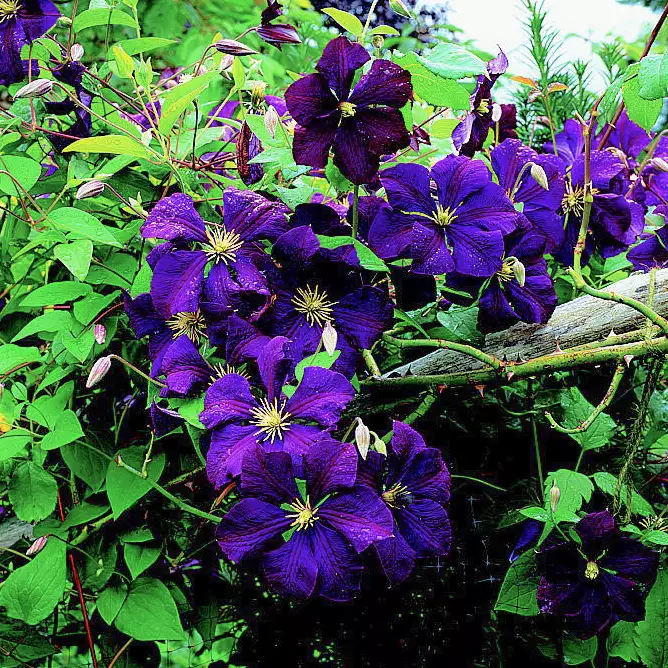
Clematis 'Jackmanii' is one of the most common—and popular—varieties. It bears dark purple flowers throughout the summer and climbs to 10 feet. Zones 4–9
'Henryi' Clematis
Clematis 'Henryi' bears huge white flowers throughout the summer. It climbs to 10 feet. Zones 4–9
'Mme. Julia Correvon' Clematis
Clematis 'Mme. Julia Correvon' bears bright magenta-red flowers all summer and fall. It climbs to 10 feet. Zones 5–9
'Nelly Moser' Clematis
Clematis 'Nelly Moser' has creamy-pink flowers with a bright pink stripe down each petal. It blooms in early summer and again in late summer. It climbs to 10 feet. Zones 4–9
'Niobe' Clematis
Clematis 'Niobe' bears deep red flowers in summer. It climbs to 10 feet. Zones 4–9
'Rhapsody' Clematis
Clematis 'Rhapsody' produces a plethora of sapphire-blue flowers from early summer to early autumn. It climbs to 10 feet tall. Zones 5–8
'Princess Diana' Clematis
Clematis 'Princess Diana' produces stunningly rich pink, tulip-like flowers all summer and fall. It climbs to 12 feet tall. Zones 4–9
Pink Anemone Clematis
Clematis montana var. rubens bears pink flowers in late spring and early summer on vigorous vines that climb to 30 feet. Zones 6–9
Sweet Autumn Clematis
Clematis terniflora blooms well even in shade, producing masses of starry white flowers with a strong fragrance in late summer and autumn. It climbs to 20 feet, and can be invasive in some areas, so be sure to check before planting. Zones 4–9
'Silver Moon' Clematis
Clematis 'Silver Moon' bears silvery-lilac flowers from summer to early fall. It climbs to 10 feet. Zones 4–9
Russian Clematis
Clematis tangutica offers unusual bell-shaped golden flowers from midsummer to fall. It climbs to 20 feet. Zones 6–9
'Veronica's Choice' Clematis
Clematis 'Veronica's Choice' bears large, semidouble lavender-pink flowers that fade to nearly white. It blooms from early to late summer and climbs to 10 feet. Zones 5–8
Garden Plans for Clematis
Foolproof Foundation Garden Plan
Dress up the front of your home with this interesting combination of plants.
Soften a Fence With This Lush Border Garden Plan
The exciting plants included in this design will provide long-lasting color, fragrance, and texture that will leave you saying, "What fence?"