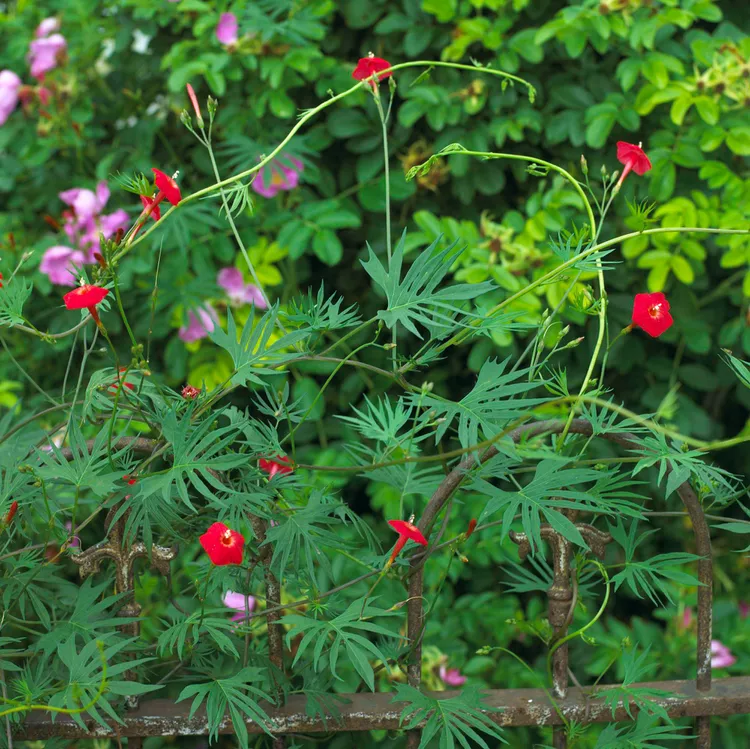

Spanish flag is a tropical vine in the morning glory genus but its showy flowers look quite different. The tubular, irregularly shaped flowers start out red and fade to orange and butter yellow, giving them a multicolored effect. The flowers form upright clusters on slender, bending stems. The vine is prized for its long bloom period from mid- to late summer until frost and for its rapid growth. It easily scrambles 18 feet or more in two months, which makes it perfect for quickly cloaking a pergola or providing shade on an arbor. In its native habitat in Mexico, it is a perennial but because it is frost-tender, Spanish flag is typically grown as an annual.
Spanish flag is toxic to humans and pets.
Spanish Flag Overview
| Genus Name | Ipomoea lobata |
| Common Name | Spanish Flag |
| Additional Common Names | Firecracker Vine |
| Plant Type | Annual, Vine |
| Light | Sun |
| Height | 8 to 18 feet |
| Width | 1 to 2 feet |
| Flower Color | Orange, Red, Yellow |
| Foliage Color | Blue/Green |
| Season Features | Fall Bloom, Summer Bloom |
| Special Features | Attracts Birds, Low Maintenance |
| Propagation | Seed |
| Problem Solvers | Deer Resistant |
Where to Plant Spanish Flag
Select a location in full sun that is sheltered from strong winds. The soil should be well-drained but in terms of pH, Spanish flag is adaptable to slightly acidic to slightly alkaline conditions.
The vine needs space and support to grow vertically. Plant it near the base of a fence, pergola, arbor, or trellis. Spanish flag is a favorite food source of hummingbirds, bees, and butterflies and by planting near a porch, deck, or patio, you’ll get the opportunity to enjoy them up close.
Pair Spanish flag with the bold textures, eye-popping colors, and intoxicating scents of other tropical landscape plants.
How and When to Plant Spanish Flag
Spanish flag is rarely available as potted nursery plants so it’s best grown from seed. The plant is slow to start and usually does not start blooming until August so it is recommended to start the seeds indoors 6 to 8 weeks before the last average spring frost date in your area, which will give you a head start on the growing season.
When plants are ready to move outside and frost is no longer likely, dig a hole roughly the size of the plant container. Remove the plant from the pot and place it in the hole. Backfill with soil and tamp it down gently. Water well and continue to keep soil consistently moist until the plant is established.
Space plants 12 to 18 inches apart.
Spanish Flag Care Tips
This tropical vine requires only minimal basic care.
Light
Plant Spanish flag in a location where it receives at least 8 hours of bright sunlight every day. While the vine tolerates some shade, it will only flourish in full sun.
Soil and Water
The soil for Spanish flag should be consistently moist but well-drained and rich in organic matter. The plant will be fine in a pH between 6.0 and 8.0.
In the absence of rain, give it about 1 inch of water per week, and more in hot, dry weather. Spanish flag can withstand dry conditions but it will affect its bloom.
Temperature and Humidity
The vine needs a frost-free climate. At temperatures below 40 degrees F, it suffers cold damage.
Fertilizer
While Spanish flag thrives in rich soil, excess nitrogen from a commercial fertilizer has detrimental effects, leading to mostly foliage growth and no flowers. Instead of adding fertilizer, it is better to incorporate a 2-inch layer of compost in the soil before planting.
Pruning
If the vine gets too dense, prune it to improve the airflow. Cut it back preferably in dry weather to prevent the spread of fungal diseases.
Potting and Repotting Spanish Flag
Spanish flag can be grown in a large container, at least 12 inches in diameter. If you already have a support in place, fill the container with potting soil in its final location, which saves you from hauling around a heavy pot. If you are planning to support the plant right in its pot, it must be deep and large enough to anchor a trellis or stakes in the pot. Pick a container that is made of a heavy material (glazed ceramic or terra-cotta), so it does not topple over. Also, make sure the container has large drainage holes. To give the container more weight and stability, line it with a layer of pebbles or small rocks at the bottom before filling it with well-draining potting mix.
Keep in mind that container plants need more frequent watering and fertilizer than inground plants.
Because Spanish flag is grown as an annual, it won’t require repotting during its single growing season.
Pests and Problems
Spanish flag is not affected by serious pests or diseases. The lack of air circulation in combination with dense foliage is a breeding ground for fungal diseases.
How to Propagate Spanish Flag
Spanish flag is propagated from seed. Start seeds indoors 6 to 8 weeks before the last average spring frost date in your area. Like its close relative morning glory, Spanish flag seeds have a tough outer layer. Break through their hard coat by nicking them, then soak them in warm water for 12 to 24 hours. Have 4-inch pots filled with damp potting mix ready and plant a couple of seeds in each, ¼ to ½ inch deep. Keep the soil evenly moist. The needs need a room temperature of at least 65 to 70 degrees F to germinate. Germination may take up to 3 weeks.
Once the seedlings emerge, only keep the strongest seedling in each pot and cut the others off at the soil level. Provide a strong light source and harden off the seedlings after all danger of frost has passed and the soil has warmed to at least 65 degrees.
Spanish Flag Companion Plants
Canna
An easy-to-grow tuberous plant with large leaves and bold flowers, canna adds texture to a garden, whether grown in a container or planted directly in the landscape. In cool climates, cannas are fast-growing plants that are treated as annuals to fill a space with color quickly. In warm climates, they create dense stands of lush foliage and vibrant blooms throughout the summer, year after year. They prefer moist soil and sunny conditions, although it tolerates partial shade. Zone 7-10
Crocosmia
The graceful arching stems of crocosmia unfurl their fiery red, orange, and yellow flowers in midsummer and fall, similar to Spanish flag. In Zone 6 or above, crocosmia comes back every year. In all other climates, crocosmia is grown as an annual. Zone 6-10
Dahlia
Grown for their beautiful flowers, dahlias come in all colors except the elusive blue. The plants are hardy in warmer regions but in colder areas, simply dig up their large, tuberous roots in the fall and replant them in the spring. Zone 8-10
Lantana
When lantana blooms, it really puts on a show with clusters of flowers in a rainbow of colors: purple, red, orange, white, pink, or yellow. The plant tolerates some of the hottest, driest spots in your yard. Like Spanish flag, it also attracts pollinators such as hummingbirds and bees. Plant in full sun and well-drained soil. Zone 8-11